Many times when you take photos, they come out dark and people's face are also too dark (especially on a beach or in snow) or sometimes faces get washed out (particularly when background is a bit darker).
Camera is a machine and many times, it doesn't understand what is in front of the lens. It is programmed (particularly in AUTO mode) to take say x amount of light (light is measured in Lumen but it is hard to interpret). So on a beach when everything is too bright, camera tries to take in x amount of light but that is too less to properly expose human faces. That is the reason we look darker on a beach, on snow or on a bright day. Opposite happens in evenings or in dull light. Camera tries to take in x amount of light but that exposes the faces too much causing people in the photo to be washed out.
Probably you are not aware but somewhere on your camera, you will see this icon or a button with + and - minus sign as shown below. It is called EV (Exposure Value) button or Exposure Compensation button. Please note that some cameras don't allow EV compensation in AUTO mode. If this is the case, hopefully, your camera has P (Program) mode and you can use it with EV compensation. Sometimes it is also referred to as Exposure Bias. Click on it and it will open up a scale or a value on your LCD.
You will see a number with + or - sign or a scale which has a value bar with values from -3 to +3 or -2 to +2 as shown below. Which scrolling button or with directional control buttons on your camera, you will be able to select any plus or minus values.
So what is the big deal about this?
By selecting a value here, you can tell your camera to take in more light or less light! This can come very handy to brighten up those dark faces or make those washed out faces more pleasant!!
To tell camera to take in more light, select any positive value. Don't rush to select too high of a value because that can wash out the whole photo! Start with +.3 or +.7 and camera will take in 30 to 70% more light. This can help get people nicely exposed in your photos.
To tell camera to take in less light, move the slider/value in the other direction. Start with -.3 and your camera with take in 30% less light!
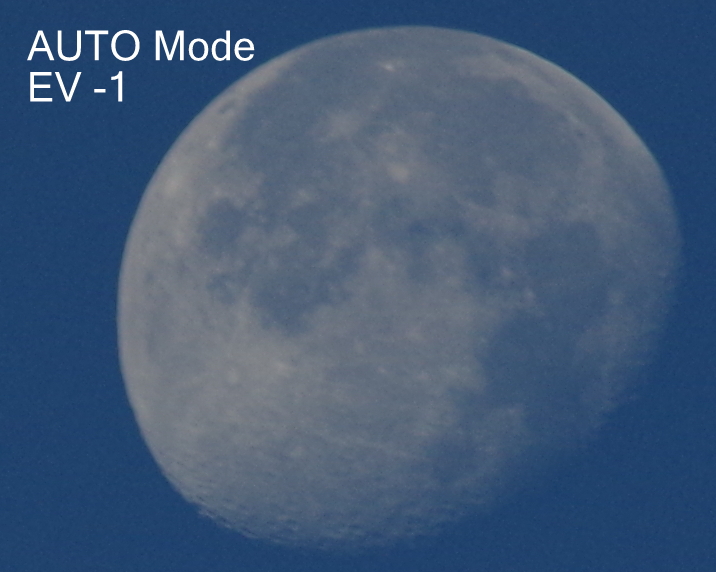
To show this with some images, I shot the moon in the sky with my camera with different EV values or Exposure bias. With 4 different images, I can pick the one that comes out better. Probably I could have take photos of people on beach to show this more effectively. However with these photos of the Moon, you can see how camera takes in less light with my pressing of the EV button!
Luckily my Pentax K-01 took the right exposure in the AUTO mode but take out your camera tonight and try to take a photo of the Moon in Auto mode. Mostly it will be washed out. Then start with negative EV values and at some value, you will have a nice capture of the Moon!
It is not the camera that always takes good photos! Many times it is a little help from the cameraman that helps camera take a nice photo.
Having used several DSLRs and mirrorless cameras, I can say Pentax K-01 is a great camera- one of the best image quality out then in below $1000 cameras. Pentax used to sell for around $900 but their gamble with the style backfired so they are clearing them out. They currently sell for around $400 with a nice 40mm 2.8 lens. Similarly, Canon was too late to enter the mirrorless camera world. They came in with Canon EOS-M with full APS-C sized sensor and started selling it for around $700. They put the fastest kit lens on this EOS-M camera compared to lens on any sub $1000 canon SLR. It comes with 22mm F2.0 lens!! This camera has same sensor and technology as Canon T4i but in much smaller body. This actually works very well for shooting HD video than most consumer Canon DSLRs. As of this writing (July 5, 2013), Amazon is selling Canon EOS-M for $299!!! Really a steal if you are buying it for less than $400. Let me tell you one major problem though! It does not come with flash! This can be a deal breaker for many and that is why I think Pentax K-01 can be a better deal for most of us. Very shortly, both cameras are likely to be selling for around $500 or more. If that is the case, look for Used cameras too. Under $350, each of these cameras are great deals IMO.
Click on the link above and read the reviews yourself. Or see the summary here. First, bad about this camera:
Lack of optical viewfinder- if you actively use viewfinder, this camera is not for you. LCD works fine for shooting but once in a while, in some bright sunlight, you will miss a viewfinder.
Orthodox style of Pentax k-01- see if you like the style. It is not bad as such. I see this style as an advantage. Most of my subjects don't take me seriously with this camera in my hand. They think this is a toy or some fun camera and I get candid photos. When I used to shoot with black bulky SLRs, mostly my subjects will become too serious or too conscious.
Flashy Yellow color- it is a bright nice color but if you don't like it, it comes in black and white color too.
Slow Auto-focus. Out of the box, the camera's AF system is slow but with firmware upgrade, it is comparable to most DSLRs. Howeve in plain contrast-less situations, like many other DSLRs, this one still struggles with AF. I immediately change to Manual focus mode and with focus peaking and Auto-zoom of the image on my screen, my workaround works very well.
Now the good about the camera:
The image quality is excellent. I have not seen such good image quality in any camera I have used so far which includes Canon T3i and Panasonic/Olymplus mirrorless m4/3 cameras.
With included 40mm lens, you can take impressive portraits and low light photos. If you like to take photos of people, this lens works out very well. In consumer grade DSLRs, Pentax K-01 has the best lens out there. Period.
If you like to take landscapes, the HDR mode does wonders. Easy to use and brings in details in shadows and highlight does not get clipped either.
With same K mount, in body Image Stabilization, and now Focus Peaking, using my Super Takumar 50mm 1.4 lens is easy and it helps get accurate focusing. K-01 body and Super Takumar lens (with combined cost of less than $400) help me take portrait photos that can compare very well with full frame $2000 plus DSLRs.
Takes HD Video but use Super Takumar above in manual mode with wide aperture for video and you will love the quality and background blurr in videos.
This camera is compact and its odd look lets you take candid photos of people. Bulky SLRs many times make people too serious while being photographed but with box type camera, your subjects are less likely to take you seriously but when you show them the photos, they will be amazed.
Very likely, in 10 years, this camera will sell for more than what you are paying today. This is my humble opinion and don't base your purchase decision on it.
Many times, you buy a new Nikon, Canon or Sony camera and also buy an expensive class 10 memory card to make sure your camera can take faster photos. Then you see your camera take 5 or more seconds to save one photo and you start doubting your camera! Probably there is nothing wrong with your camera. The new cameras have faster processors. However manufacturers are adding more and more features in new cameras. Nikons have smile detection, blink prevention. Sony cameras have background blurring and HDR in the AUTO mode. These are just some examples. Modern day cameras are so features-rich, sometimes we have to sacrifice certain other things. We have to bear with slower speed. That doesn't mean Sony or Nikon cameras are slow or have slow processors. Sony camera models like DSC-HX10V offer background blurr where actually two or more photos are taken and they are combined to give you SLR like background blurr (bokeh). This can cause you to wait for 5 seconds. If waiting bothers you, turn this off if your camera has it.
Background Defocus
DSLR photographs are often beautiful because they blur the background, putting the emphasis on the subject. Now our point-and-shoot cameras can deliver this signature DSLR benefit. The system takes two shots, identifies the background and applies a defocused background keeping the subject crisp and clear.
Superior Auto mode Get cleaner, more dynamic pictures and fewer missed shots. The DSC-HX10V automatically recognizes the correct scene mode, then quickly shoots and combines up to six shots to produce images with greater clarity, optimum dynamic range using backlight correction HDR technology and lower image noise using 6 shots layering technology. Superior Auto intelligently detects 33 scenes for still images and movies, making it easy to get the best shot.
So instead of worrying about slower camera speed, you should look at what the camera is doing for you. If the slower speed bothers you, look into your camera menu and disable such features. You will note significant improvement in picture taking speed.
Also, to get better out of your memory card, format it within a camera. This way, the camera will optimize cluster size, allocation block size etc to get you optimum storage capacity and speed.
One more thing that effects camera's processing. It you are taking photos indoor or in dull light, sometime camera has to keep the shutter open too long. That can affect the speed of your camera.
Many people love their iPod, iPad, iPhone or any smartphone as such, for the nice photos it takes. It is true that in good light and in outdoor bright places, these instruments take nice photos. Also, they have very optimized display so even an okay photo will look bright and nice on any smartphone or on iPod/iPad. However in many situations, iPod or any camera as such will run into its hardware restriction. Because of its sensor's size and size/quality of lens, iPod/any smartphone can't work well in certain lighting situations. However if you are willing to help, you can still have better photos in some situations where your smartphone alone simply fails.
Here are certain things YOU can do to improve your photos in low light:
1) Shoot in good light. Avoid shooting in low light, indoor or in dark places. Outdoor and in well-lit places, your iPod will take nice photos but when light gets low, its tiny sensor and tiny lens can't take in enough light in 1/50 seconds which is required to take nice photos of people or moving objects. 2) In low light or indoors, if possible, turn on artificial light. If you are in a room, turn on lights or use flash lights. If there is a flash on iPod, use it. 3) If you are shooting stationary items or very slow moving objects, put your iPod on some steady surface (instead of holding in hand) and that can eliminate blur in your photos. 4) Also, you can enhance photos with Picasa or similar software to some extent. There are many such software out there. 5) Not sure what kind of manual controls, iPod offers. If my iPhone5 is any clue, you can't do any thing to control iso, aperture or shutter speed. So except about tips, there isn't much you can do with your iPod.
I keep coming across such questions. Which DSLR camera to buy? Canon or Nikon? Or a Sony? Which model? Which one of the following is a better camera? Canon T4i, Canon 60D, Canon T3i, Nikon D5100, Sony NEX or Pentax K-5? Most first time DSLR buyers spend a lot of time in making sure that they make the right purchase. They keep debating for weeks if not months to find out which camera is the best. They would visit dpreview.com for detailed editorial reviews or Amazon.com for user reviews. They go on websites like snapsort.com to compare specs. Now if you are one of them and you are reading this post, I am going to make your life easy. By the way, by looking for the best camera in your first SLR purchase, you are not doing anything wrong. I did it too when I bought my first DSLR in 2005. However having bought and used several DSLRs and Hybrid/Mirrorless Cameras over last 2-3 years, I can say that all modern day DSLRs or Mirrorless are very capable cameras. You won't go wrong buying anyone of them. If you spend too much time researching or justifying a particular model, it is likely that you will not be happy in the end. Buyer's remourse will likely haunt you. Even after your purchase, you will keep trying to justify it or feel sad that why you didn't buy the other model you were interested in. In reality, all modern SLRs have more than most of us need or will ever use. Please don't make your purchase unnecessarily complicated.
IMO, there are 3 important things behind a great photograph: The light, the photographer and then comes the equipment. In the equipment category too, I think camera lens is a more critical factor than the camera body when the light is low or challenging. This is generally speaking. I am trying to keep this simple and useful.
War Between Canon Vs Nikon
If you go online, you will find a virtual war. People who have bought Canon cameras would recommend you a Canon DSLR. A person who has Nikon would keep bashing Canons!! I am often surprised to see why people become free sales-reps or marketers for these brands. They don't get paid by those companies! Then why do they fight among themselves like UCLA Bruins and USC Trojan fans? This puzzles me. It is good for the companies though. Who doesn't like loyal free workers/marketers? LOL. The only justification I have behind such consumer behavior is after having invested lot of time behind their own DSLR purchase, most consumers are probably still trying to justify if they made the right choice. So at every opportunity, they would stand up for the brand they have purchased. On Yahoo Answers, everyday you will see ten plus questions where a person is seeking an advice for buying the best camera. Look at the responses. Someone will recommend a Canon. Someone will recommend Nikon or Pentax. You will not find someone saying that Nikon and Canon both make wonderful cameras. So if a friend recommends you a Canon, don't blindly follow him. If a friend is not happy with Nikon, it may be because he doesn't know who to use or what to expect from a camera. Or he may be taking photos in low light. If you were to believe me, please note that Nikon, Pentax, Panasonic, Olympus and Sony- they all make equally good cameras. Specs may differ a bit here or there but their sensors, image processing engines are very powerful for most amateur users, like you and I. If you are a professional who will be paid for the photos, I am sure you are not reading my blog LOL.
Nikon? Canon? Sony? Pentax?
* All modern day cameras have very good sensors and are very capable cameras. You will not go wrong buying anyone of them. We strive to buy the best entry level digital SLR but 95% of us, yes 95% of us, don't use more than 30% of what a camera has to offer. Nikon, Canon, Panasonic, Sony, Pentax, Olympus- they all make very capable cameras. * A Nikon lover may say that Nikons have bigger sensor than Canons (22.2 x 14.8 mm for Canon vs 23.5-23.7 x 15.6 mm in most Nikon, Sony or Pentax cameras). If you see the numbers, it is only a marginal difference. This marginally bigger size in Nikon cameras doesn't prove that Canon SLRs are worse than Nikons!! If Canon T3i takes 5 fps vs T4i which let us say takes 7 fps. Should you care? Not really. Not 95% of us. Most of us rarely use this multiple shots features! Then why bother? * Every camera has some strengths or weaknesses. Product differentiation, right? Let me help you choose a right camera for you. You can fall in one of the following two groups. Group 1: Looking for the best DSLR out there. If you are in the market for your first entry-level SLR and all you want is to buy the "best" camera, go to a deal website like Fatwallet.com or Slickdeals.net and see which camera has a good deal. If you like that camera, buy it. As long as you use your camera in good light, you will love it. Group 2: Looking for the best DSLR **for you**: If you know what you are looking for, you have a right to choose your camera LOL. Make a list of things you need and you are allowed 4 to 14 hours to do your research to find out a camera that best meets your requirements. Don't spend more time than that. Now you can spend 40 hours or even 400 days to wait for the camera to be available in your budget. Or you can go on www.amazon.com and make your purchase. * Mirrorless or Hybrid cameras are as good as bulky DSLRs. However they are easy to carry around and people are more likely to give you more candid poses in front of a small mirrorless camera or awkward looking Pentax K-01 than in front of a professional looking DSLR. If you are an AUTO-only user, you should seriously consider latest Olympus, Panasonic or Sony NEX cameras. If you can look beyond Canon and Nikon, you should also consider Pentax cameras. They offer the best value IMO. I have photos with variety of cameras on my Flickr. Most of the photos are with cameras that costed less than $500 ;) See then below.
Cameras Are Not Bad. Sometimes they are used in bad light. Or in bad situations.
It is funny sometimes a prospective DSLR buyer not liking Canon T4i because his friend is not happy with it. Ironically, his friend may be using the camera, without knowing anything about it, in AUTO mode indoor or in low light. No entry level camera will do a good job in low light unless you know to boost up ISO or use a fast lens or a tripod (if you are shooting a landscape or a sun-set). A $100 camera, 5-6 year old model, off of eBay will take as good photo as a $1000 camera in outdoor good light. Even your iPhone will take good photos outdoor. However start using the same camera indoor or in low light and you will see most cameras start failing miserably. Doesn't matter if it is T3i, or D3200. Or even T6i!!!
Some Tips to get the best out of your first DSLR
Instead of searching for "best DSLR", you should spend your time to learn things that can help you take better photos with your camera. 1) Read photography blogs or tips online to be a better photographer. Any camera can do only limited things but with some tips, you will be able to take your camera to the next level. You will have better chances for better photos. 2) Buy some prime fast lens like 35mm or 50mm with F1.8 or so. For Canon or Nikon, you can get one for around $100-$150. With this lens, your DSLR will be able to take photos in low light too. Plus for taking photos for people and pets, they give nice bokeh- background blurring that you see in portraits taken by professionals. 3) Read your camera manual. You will be amazed to know how much your camera can do besides that AUTO button. 4) Work with your camera. Your camera can do only certain things for you. When you are taking a photo, it tries to guess what it is shooting and would set up Aperture, Shutterspeed, ISO, color mode etc to shoot a photo for you. Many times that piece of glass (I mean lens) and that sensor does not know that you shooting in backlight or in snow. It does not kow if you are taking photo outside in broad sunlight or indoor well-lit place. If camera does not know accurately what it is shooting, it will probably give you a bad photo. Now instead of blaming your camera for a bad photo, if you are willing to work with your camera, your camera can take better photos for you. Learn some basic photography tips and help out your camera when it struggles. Set a proper mode like Portrait, Landscape, Macro, Sports and tell your camera where and what you are shooting. If your camera takes too bright or too dark photos, set the Exposure Compensation and tell camera to take less or more light. With your little help, you and your camera can make a great pair and together you will be able to take better photos.
Enjoy Photography. If you like this article, please share it on Facebook or Twitter. Free your friend who is deciding for last 6 months whether to buy Canon T4i or Nikon D3200!